You find a home you love, then the real question hits: how does home financing work when you have to balance price, payment, credit, and timing all at once? For most buyers, home financing is simply the process of borrowing money to purchase a property, then repaying that loan over time with interest. The details matter, though, because the right loan can make buying feel manageable, while the wrong one can stretch your budget for years.
How does home financing work from start to finish?
At its core, home financing has a simple structure. You contribute some of the purchase price, usually through a down payment, and a lender funds the rest. In exchange, you agree to repay the loan in monthly installments over a set term, often 15 or 30 years.
Those monthly payments usually include principal and interest. Many borrowers also pay property taxes and homeowners insurance through the monthly payment, which are collected in an escrow account. If the loan requires private mortgage insurance, that may be included too.
The property itself serves as collateral. That means the lender is taking a measured risk based on your income, assets, credit profile, debt, and the value of the home. This is why financing is never just about the home price. It is about whether the full payment fits your financial picture.
The main parts of a home loan
To understand how home financing works, you need to know what drives cost. The first is principal, which is the amount you borrow. The second is interest, which is what the lender charges for lending that money.
Then there is the loan term. A longer term, like 30 years, usually lowers the monthly payment but increases total interest paid over time. A shorter term, like 15 years, often comes with a higher monthly payment but less interest overall.
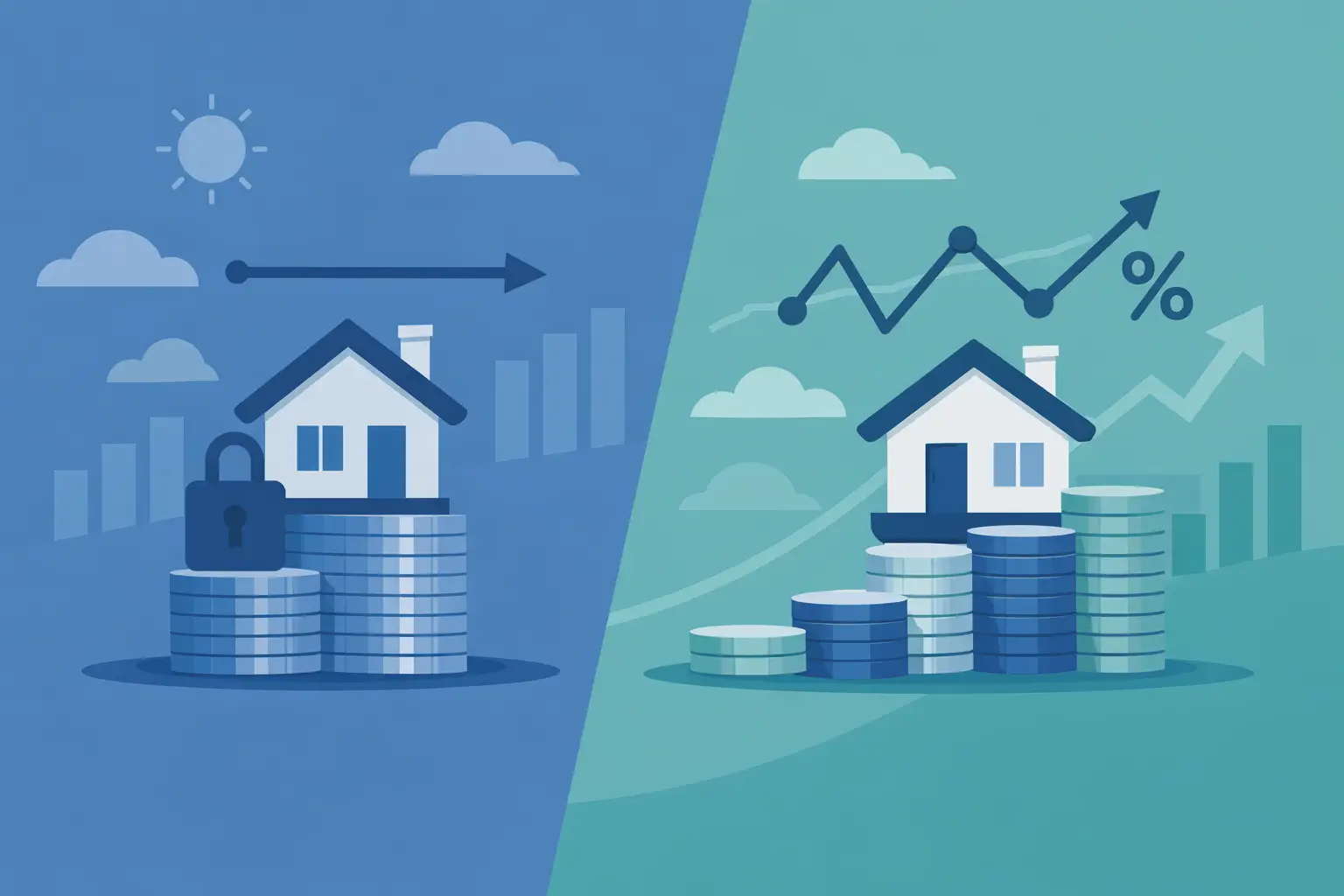
The interest rate can be fixed or adjustable. A fixed-rate mortgage keeps the same rate for the life of the loan, which gives borrowers payment stability. An adjustable-rate mortgage starts with a lower rate for an introductory period, then adjusts later based on market conditions. That lower starting payment can help in some cases, but the trade-off is future uncertainty.
Closing costs are another piece borrowers cannot ignore. These are the fees tied to originating and finalizing the loan. They can include lender fees, title charges, prepaid taxes and insurance, and other transaction costs. A low rate does not always mean a lower overall deal if the fees are high.
What lenders look at before approving financing
Approval is not random. Lenders evaluate whether you are likely to repay the loan and whether the property supports the loan amount.
Income is a major factor. Lenders want to see that you earn enough to comfortably handle the proposed housing payment along with your existing debts. That is where debt-to-income ratio comes in. If too much of your monthly income is already committed to car loans, credit cards, student loans, or other obligations, your options may narrow.
Credit history also matters, but not in the oversimplified way many buyers think. A stronger credit score can help you qualify for better pricing and more choices. A lower score does not always mean you are out of the market. It may mean a different loan program, a larger down payment, or a closer review of compensating factors such as reserves or stable income.
Assets are reviewed as well. Lenders typically want to verify that you have enough funds for the down payment, closing costs, and in some cases reserve funds after closing. They also review the source of those funds to meet lending guidelines.
Finally, the home itself must appraise. If the property value comes in lower than expected, that can affect financing because the lender will not base the loan on an inflated price.
Prequalification, preapproval, and underwriting
These terms are often used interchangeably, but they are not the same.
Prequalification is an early estimate based on information you provide about income, assets, debts, and credit. It can be useful for planning, but it is not as strong as a full review.
Preapproval is more meaningful. It usually involves reviewing documentation and credit in greater detail. This gives buyers a stronger sense of their budget and can make sellers take their offer more seriously.
Underwriting is where the loan receives a deeper review before final approval. The underwriter checks income documents, bank statements, tax returns when needed, employment history, credit, property details, and compliance with program rules. Sometimes the file is approved quickly. Other times conditions need to be cleared before closing.
This is one reason borrowers benefit from working with a lender that offers broad product options. If one path does not fit, another may. Conventional financing may work for one borrower, while FHA, VA, USDA, bank statement, or alternative income financing may be a better match for another.
Common ways buyers finance a home
Conventional loans are among the most common choices. They often appeal to borrowers with solid credit, stable income, and a down payment that meets program requirements. These loans can be very competitive, but the best terms usually go to borrowers with stronger overall profiles.
FHA loans are designed to expand access to homeownership. They can be a strong fit for first-time buyers or borrowers with less-than-perfect credit. The trade-off is that mortgage insurance costs can be part of the package, which affects long-term payment.
VA loans are built for eligible veterans, active-duty service members, and certain surviving spouses. They can offer major advantages, including flexible qualifying features and, in many cases, no down payment requirement.
USDA loans support eligible rural and suburban homebuyers who meet income and property requirements. For the right borrower, they can provide a low-down-payment path or even no down payment financing.
Not every borrower fits neatly into traditional income documentation. Self-employed buyers, business owners, and commission-based earners may need bank statement or alternative income programs. These loans can open doors that standard underwriting closes, though pricing and qualification terms can differ.
Down payment, mortgage insurance, and monthly payment reality
A lot of people assume they need 20 percent down to buy a home. Sometimes that is true for avoiding private mortgage insurance on a conventional loan, but it is not a universal rule for getting approved. Many buyers purchase with less.
A larger down payment can reduce the loan amount, lower the monthly payment, and strengthen the overall file. But using every available dollar for the down payment is not always the smartest move. Some borrowers are better served by keeping extra cash for reserves, repairs, moving expenses, or emergencies.
Mortgage insurance is where the monthly payment can surprise people. If you put less than a certain amount down, or if you use certain government-backed programs, you may pay mortgage insurance. That cost protects the lender, not the homeowner, so it is worth understanding exactly how long it lasts and whether it can eventually be removed.
This is why the smartest question is not just, Can I qualify? It is, Does this payment still work if taxes rise, insurance increases, or life gets more expensive next year?
Interest rates and why timing matters
Rates affect affordability immediately. Even a modest rate difference can change your monthly payment and the total amount paid over the life of the loan.
That said, rate shopping should not stop at the headline number. You should also compare lender fees, points, mortgage insurance structure, and flexibility if rates drop later. A lower rate with higher upfront costs may or may not save you money depending on how long you expect to keep the loan.
This is where long-term thinking matters. Some lenders treat the transaction like a one-time event. Others are built to help borrowers keep saving after closing. US Mortgages, for example, positions financing as an ongoing relationship with options that can reduce repeat refinance costs for eligible borrowers when rates improve. For homeowners who plan carefully, that kind of structure can matter just as much as the initial quote.
What happens at closing and after
Once the loan is fully approved and closing disclosures are finalized, you sign the legal documents that complete the financing. You will pay your required cash to close, ownership transfers, and the lender funds the loan.
After that, repayment begins according to the loan terms. Early in many mortgages, a larger share of the payment goes toward interest rather than principal. Over time, that balance shifts.
Home financing also does not end at purchase. Later on, homeowners may refinance to lower the rate, change the term, or tap equity through a cash-out refinance or HELOC. Others may use financing strategically to eliminate mortgage insurance or move from an adjustable rate to a fixed one. The best loan is not only the one that gets you into the home. It is the one that still makes sense as your finances evolve.
If you are asking how does home financing work, the most useful answer is this: it works best when the loan matches your income, goals, and future plans, not just the price tag on the house. Buy with clarity, not pressure, and the numbers will serve you long after closing day.